

Psychedelics have come a long way since the hippy days of the 60s, cleaning up their reputation considerably along the way. Once known only for their hallucinogenic effects, they are now widely recognized as powerful tools against not only psychological disorders, but other brain-based troubles like neurodegenerative diseases and pain.
In fact, the use of psychedelics for spiritual and therapeutic purposes goes back millennia, due to their ability to induce altered states of consciousness. The modern classification includes well-known classics like LSD (lysergic acid diethylamide), PCP (phenylcyclohexyl piperidine), MDMA (3,4-methylenedioxy-N-methylamphetamine, or "ecstasy"), psilocybin and ketamine.
Whether their effects are hallucinogenic (altering perception and thought), empathogenic (promoting emotional connection and openness), oneirogenic (provoking states of lucid dreaming) or dissociative (inducing a sense of detachment from environment and self), what they all have in common is that they profoundly transform the way we perceive the senses, the self, time and space, a power that is now being harnessed to help heal the brain.
Psychedelics go Mainstream
Although their use in religious and medicinal practices dates back thousands of years, Western medicine started to take interest in psychedelics with the accidental discovery of LSD in the 40s. This lead to a boom of psychedelic-based therapies in clinical practice in the 50s (especially with the newly discovered LSD), before the hippy movement ruined their reputation in scientific circles in the 60s.
They began to regain popularity in medical research in the 90s and have since grown from strength to strength. Although the only FDA approved psychedelic on the market is esketamine, (available under the brand name Spravato as a nasal spray for treatment-resistant depression), there are currently 70 clinical trials underway for LSD, 105 for MDMA (including one currently recruiting for the treatment of Pathological Narcissism), and a whopping 241 for psilocybin.

As these numbers confirm, the most studied of the psychedelics is psilocybin, a naturally occurring compound produced by hallucinogenic mushrooms, whose clinical indications in psychiatry include anxiety, depression, PTSD and addiction. It has also been studied, together with LSD, for treating chronic pain, and is thought to alter pain perception via its effects on serotonin receptors and synaptic remodelling, as well as its anti-inflammatory effects.
An interesting and more recent trend is the transition from purely psychiatric applications to neurology, and psychedelics are now being studied for their potentially beneficial effects on neurodegenerative diseases like Alzheimer’s. The classic psychedelics are known to stimulate certain signalling pathways in the brain that atrophy during Alzheimer’s, as well as promoting neurogenesis and neuroplasticity, all of which could potentially combat neurodegeneration.
Overcoming unusual Clinical Challenges
Of course, their strong mind-altering nature, potential for recreational use and abuse, and the risk of side effects makes the development of psychedelics as therapeutics a bit of a regulatory nightmare, as well as presenting some rather unique clinical challenges.
MDMA for example, has shown promise in the treatment of psychiatric disorders, particularly PTSD, due to is empathogenic effect (incidentally also the reason it was such a hit as a party drug in the 80s). However, the drug also comes with some nasty side effects, including tachycardia, high blood pressure, liver and nerve damage.
A recent, highly publicised application by Lycos Therapeutics to obtain FDA approval for MDMA-assisted therapy for adults with PTSD was rejected despite positive Phase 3 clinical trial results for this very reason. While the regulators expressed a number of concerns, one of the main reasons cited was that the benefits simply did not outweigh the risks.
This has led to a push to develop of variants of MDMA that retain the positive effects while reducing the negative side effects. A study published in 2024 in Neurochemistry identified four MDMA variants that have similar effects on the relevant brain receptors (serotonin, dopamine, and norepinephrine), but release fewer toxic metabolites when broken down by the body.
Another potential complication of psychedelic therapies is that the high they produce can last several hours, in which the patient can obviously not be left to their own devices. The therapies are therefore clinically intensive, requiring supervision during the treatment, and psychological support before, during and after. Psilocybin-based treatments, for example, last 6-8 hours, a full day’s work for the supervising clinician.
A company called Gilgamesh Pharamaceuticals addressed this particular challenge with a next generation psychedelic antidepressant called bretisilocin, whose effects last a respectable 60 to 90 minutes. The drug has shown remarkable results in a recent Phase 2a trial, with 94% of patients in remission after a month of treatment and only mild adverse effects reported. So much so that AbbVie just announced the acquisition of bretisilocin for a cool $1.2 billion.
Finally, there is the fact that the double-blinded placebo-based clinical trial gold standard is somewhat undermined by the obvious differences in behaviour between those receiving the drug and those receiving the placebo, leading to involuntary unblinding of the trials. One way that researchers are trying to address this is by lowering to dosage to a level at which the behavioural effects are imperceptible, a tactic that was used in Gilgamesh’s trials with bretisilocin.
Drugless Psychedelic States?
And then there is the more esoteric approach: achieving the same effect without drugs. A recent publication outlines how so-called high ventilation breathwork (HBV) combined with music can invoke altered states of consciousness similar to those created by psychedelic drugs and believed to be crucial to their therapeutic effect.

HBV involves increasing either the rate or depth of ventilation, and it provokes profound changes in blood flow to the areas of the brain responsible for respiratory interoception (the way your brain processes internal breathing-related bodily signals) and processing emotional memories, which in turn can lead to altered subjective experiences that include euphoria and a sense of oneness with the universe.
The breathwork exercise used in this particular study consisted of 30 minutes of continuous cyclic breathing accompanied by “progressively evocative music”, and participants were asked to report their own subjective experiences via pre-and post-session questionnaires, as well as being monitored via MRI and electrocardiographs.
Results indicated that both the nature and magnitude of the subjective experiences were similar to those experienced by patients undergoing psychedelic therapies. And interestingly enough, similar alterations in blood flow are observed in the same brain regions during treatment with psychedelics.
That being said, is it just me, or does taking shrooms with your shrink seem like way less work (and a lot more fun) than hyperventilating for half an hour?
Beyond the Brain: The Longevity Link
There’s a further interesting aspect to the use of psychedelics that is only just beginning to be explored. Studies have shown that negative psychological states like depression, stress and anxiety accelerate telomere shortening, effectively making you age faster, while positive psychological states are associated with longer telomeres. This leads to some interesting questions. How do psychedelics affect cellular aging? And could the effectiveness of psychedelics against psychiatric disorders somehow be related to this telomere effect?
A study from July this year looked beyond the brain to provide the first experimental evidence of the direct impact of psilocybin on biological aging. Specifically, the researchers showed that psilocin (the active metabolite produced when psilocybin breaks down in the body after ingestion) extends the lifespan of human cells and that psilocybin treatment promotes increased longevity in aged mice.
It does so by influencing a state called replicative senescence. Every time a cell divides, the telomeres (the protective caps at the ends of our DNA) shorten just a little bit. This limits the number of times cells can divide, and eventually they cease to divide altogether (the state of replicative senescence) which leads to aging and age-related diseases of the organism.
The first part of the study involved treating human foetal lung fibroblast cells with psilocin in vitro, and monitoring its effect on cellular lifespan, measured by how many times the cell population doubled and how long it took for the population to double. They demonstrated dose dependent increases in cellular lifespan of up to 57%, a result that was confirmed when the experiment was repeated on adult human skin fibroblasts.
The treated cells also exhibited reduced DNA damage and oxidative stress, and assessment of their telomere lengths showed that the treated cells preserved their telomere length while the control group did not. All of this suggests that psilocin affects cellular aging signalling pathways to delay the onset of senescence.
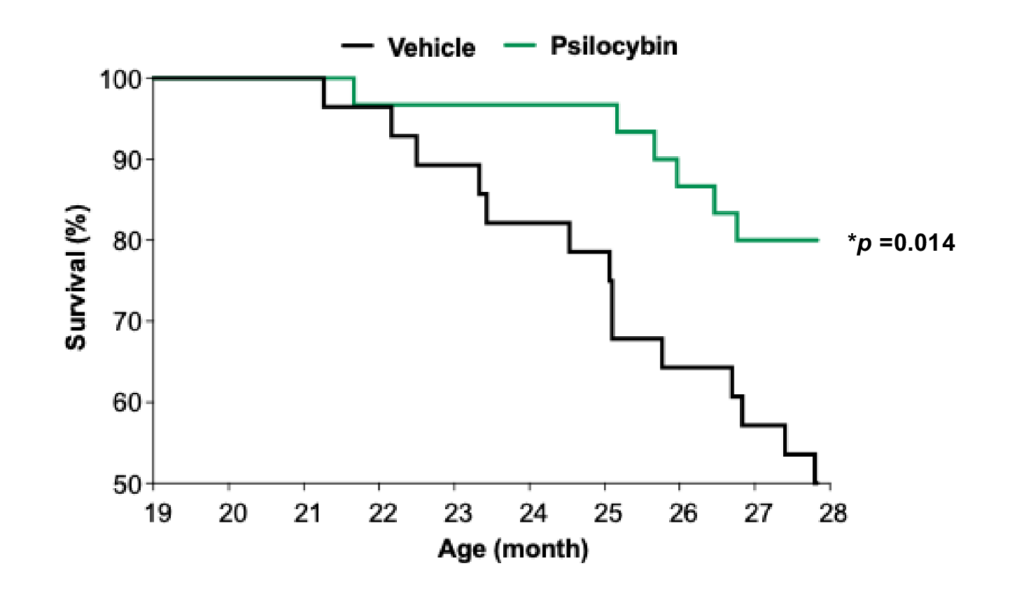
In vivo experiments on aged female mice (and in mice terms “aged” means 19 months, roughly equivalent to 60-65 human years) followed. Our elderly furry friends were given psilocybin once a month for 10 months, and indeed, 80% of the treated mice survived to 28 months compared to only 50% of control group, as well as maintaining youthful fur quality well into their final months (although this proved impossible to quantify).
As an added bonus, some of the mice experienced weight loss (albeit not a statistically significant one, and I’m not sure mice really care), plus they got to enjoy ten complementary hallucinogenic highs (apparently their heads starting to twitch is an established behavioural indicator that they are tripping balls). Not a bad way to spend your old age, if you ask me!

Sintonitza amb el futur de la Salut
Uneix-te als nostres més de 20.000 subscriptors per conèixer l'últim en inversió i innovació en biotecnologia


* Què estàs acceptant?
1 correu setmanal amb un article sobre avenços científics sorprenents i un article (de vegades) enginyós sobre innovació i inversió.
1 correu setmanal amb actualitzacions sobre les inversions de Capital Cell en noves empreses al sector Salut.
Aquesta no és una daquestes subscripcions de "oh no, el meu correu electrònic és a Internet". Mai no vendrem mai, enviarem o transferirem les teves dades a ningú més. A més, pots cancel·lar la teva subscripció en qualsevol moment sense que seguim enviant correus electrònics descaradament; si ens demanes que et deixem en pau, ho farem.