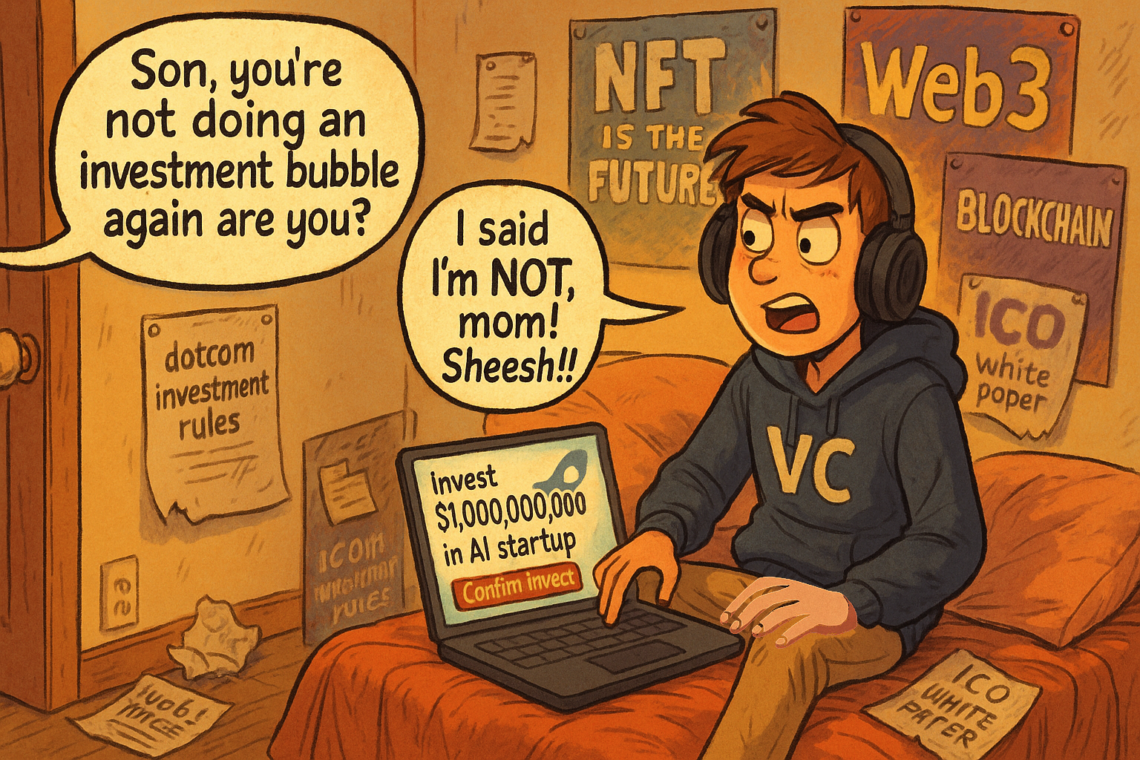

Financial bubbles have a very bad reputation, and, in part, it may be because of tulips. In 1630, the world went tulip crazy; a temporary shortage, combined with the emergence of innovative financial products such as futures agreements, caused their price to skyrocket inconceivably. A single tulip bulb fetched as much as a house.
Of course, that kind of thing has given irrational behavior a bad name, but let’s be mature here: a bubble is a bubble, and there’s nothing wrong with it. Financial stupidity doesn’t necessarily mean that the underlying asset is stupid.
For example, the dotcom bubble was silly, but it doesn’t mean the internet is pointless: that’s where we keep pornography and cat pictures (300 million gigabytes in total), which is useful. The housing bubble was stupid too (and evil), but that doesn’t demerit the usefulness of houses: you probably live in one yourself. The railroad bubble of the 1840’s was silly, but trains are great nonetheless, even if they’re not as glamourous as they used to be. The crypto bubble was stupid, but that doesn’t mean that the whole thing was… ermm… well, yes, that one was a scam.
The point is, the world tends to go crazy over things that do merit a lot of attention, just maybe not that much. If we’re being honest, biotech investment was a repeat bubble: the capitalization value of biotech companies in NASDAQ almost doubled from 2013 to 2015, only to drop by 40% in about six months. It took 5 years for NASDAQ:Bio to get back to 2015 levels; then it boomed again in, only to crash violently in 2022.
In fairness, the 2020 craze wasn’t just for biotech: the pandemic era was a boom for all technological startups. The videocall platform Zoom, for example, was worth 160 billion dollars in October 2020, more than Fiat, Sanofi, Ryanair and BNP-Paribas put together. To nobody’s surprise, the whole thing came crashing down rather rapidly once things returned to normal.
The 2022 bust was hard on all sectors, and biotech was no exception. Biotech venture funding worldwide topped $70 billion in 2021 (when global venture funding reached an all-time record of $640 billion), and by 2023 it had collapsed to roughly $15 billion on an annual basis, a solemn 80% drop. And the hangover continues: The second quarter of 2025 saw just $4.8 billion invested, while new company formation hit decade-low levels both in the US and in Europe.
All over the world, startup founders who once chased sky-high valuations were (and still are) desperately gasping for any funding they can find, like fish stranded in a puddle by a receding tide.
Many other superstar sectors are equally stranded: fintech, media, aerospace, renewables… so, it would be fair to wonder if the model of Venture Capital (high-risk/high-yield startups) still makes sense. Are we looking at the downturn of a cycle that will shoot back up? Or is this a deep transformation—a redefinition of paradigms that will transform innovation investment forever?
Finding an answer to this enormous question seems far too difficult, but I haven’t written this whole article just to say “meh, the data is unclear”; I might as well just have asked ChatGPT to slap together “2000 words of generic dribble about investment”.
So, an answer: no, it is not a transformation; it is a cycle. There, it is said, and while this may not be the absolute truth, let's follow the thread and see if it makes sense.
The reasoning here is that too many signs point in the same direction, which is that men and money are still men and money, and that the same financial patterns have been repeating since the 16th century. We are seeing more of the same, and it’s fair to guess that the situation will correct itself just as it always does: slowly, and painfully.
It's a cycle
The basic cycle is as follows: driven by low interest rates, excess cash or simply market euphoria, private equity raises a lot of money, and invests it aggressively in companies that promise huge 'exits' (sales of companies with gigantic increases in value).
This worked great in 2020, when borrowing money was almost free and startups turned into billion-dollar unicorns overnight. But then inflation hit, central banks hiked interest rates, and the “borrow, invest, buy at any price” model started looking somehow uncertain. Suddenly, investors had safer places to park money (hello, tourist flats and treasury bonds), and the fear of missing out on the next big California Unicorn turned into fear of overpaying for a flop. Venture firms pulled back hard in 2022–2023, raising their bar for new investments and focusing on shoring up existing portfolios.
Moreover, the big exits disappeared in 2022: by 2024, the average profitability of IPO's was -50%. But venture funds need exits to keep their investors happy, and individual investors (yourself, perhaps) need to make money to avoid feeling duped. The funds saw their returns evaporate, and their investors became extremely wary of contributing more capital. And if funds don't get paid, they don't pay. In 2023, venture funds globally pulled back firmly, and startup funding fell by 40%.
With high interest rates, speculative investments have faced a permanent headwind, and venture investors have favored “safer” bets with clear paths to profitability or clinical success, rather than spray-and-pray investing in just about any CEO with a turtleneck.
In short, capital shifted to fewer and less risky deals: the market has shifted to a “winner takes all” dynamic where investors put all their money in mature companies that are closer to success. From 2023 to 2024, the number of “mega-rounds” (+$100M) went from 42 to 72, sucking up almost 70% of all venture capital money (compared to 41% in 2021).
And so the cycle continues. Investors become less risk-prone, and as more and more companies seek investment from less and less eager investors, the balance of bargaining power shifts toward capital, and startups have to reduce their valuations. Today, you can invest in startups with revolutionary drugs proven in solid clinical trials at valuations 5 to 10 times lower than in 2020. They are also better companies: more streamlined, less arrogant.
As this happens, bargains appear and the profits, when they come in, are stunning. Then other investors want in: what is this profitable sector? Can I invest? And, once again, capital floods into the sector. Valuations spike up. Companies become less competitive, mediocre founders and startups become ultra-valuable. Investors start acting impulsively and paying huge prices for companies they have barely analyzed, and asset quality becomes irrelevant to investment decisions. Flops start to flop. Panic sets in. Then the circus collapses; money flees to safer destinations, investors become risk-averse. Companies find it difficult to raise funds and are forced to improve their management and lower their valuations. And heeere we go again!
And so on until the end of time, amen.
It's a bubble
There is an even clearer symptom that the investment sector is not transforming at all: we are living through an unmistakable investment bubble, the best possible hallmark of “business as usual”.
As investment collapses, there is one group of tech companies popping champagne: artificial intelligence (AI) startups. It's as if all the attention (and money) in the world has decided to focus exclusively on AI, and leave tech companies in all other sectors lying around like old rags.
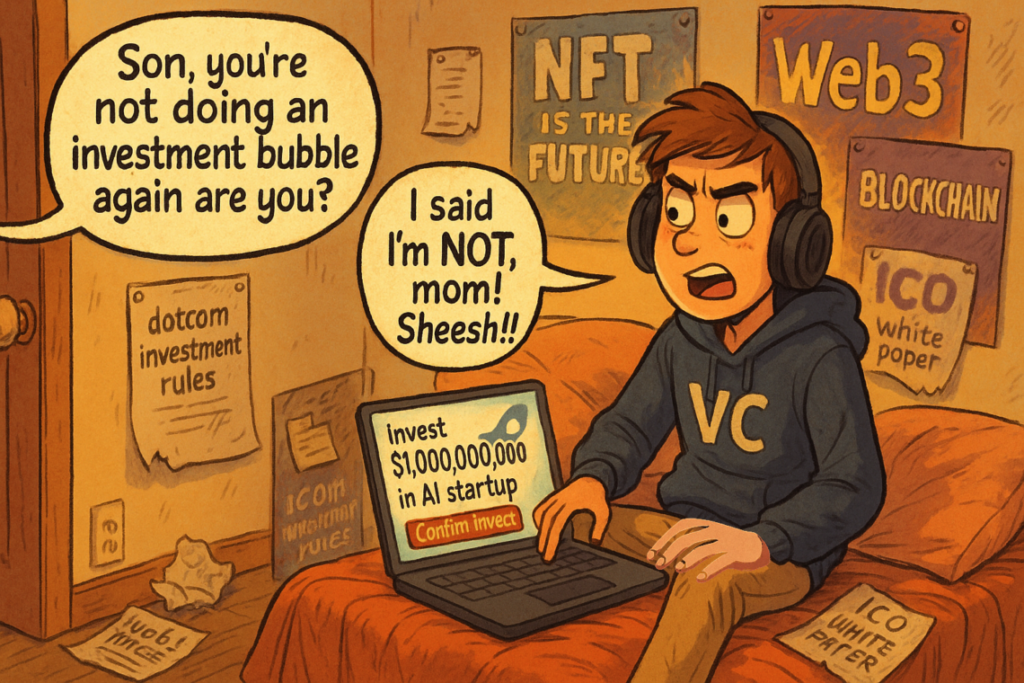
In 2023 and 2024, while most sectors saw funding dry up, AI startups saw a flood. Global funding in AI startups actually grew 9% in 2023, to roughly $50 billion, even as overall venture funding fell by over a third. By Q4 2024, the trend was extreme: A staggering 50% of all VC dollars worldwide went to AI-focused companies. In that single quarter, five U.S.-based AI companies raised over $32 billion between them (OpenAI, Anthropic, and other “generative AI” players). Yes, half the money in the global startup ecosystem went to AI in that period, leaving every other sector to share the remaining half..
And while a deep understanding of the AI phenomenon would seem necessary to analyze such a complex matter, we will instead look at a few funny flops from previous bubbles and compare them to some current obvious billion-dollar AI boondoggles. That’s both a laugh and a reasonable analysis.
It's rubbish
Pets.com
A dotcom bubble (1999-2001) classic, Pets.com raised over 82 million dollars on Nasdaq in 2000 and was liquidated in nine months. The company spent so much money on marketing (including iconic cringe ads in the Super Bowl) that the thin margins of pet-shop products couldn’t have covered it even if every American had eaten nothing but dog food (although, come to think of it, they’re not that far from it).
Boo.com
Of all the dotcom-era failures, the online clothing portal Boo.com may well be the funniest. It's hard not to laugh when someone burns $135 million in one year to launch arguably the worst website of all time, a monstrosity so bulky and poorly designed that it literally took minutes to load each page. You can relive the experience using this link from the Internet Archive: http://web.archive.org/web/20010927092825/http:/boo.com/.(remember: you have 5G, in 1999 they had 56k modems).

The anything ICO
2018 was the heyday of ICOs (Initial Coin Offerings), a novel way of raising funds using cryptocurrencies and 'tokens' (something like "digital stocks"; it's actually more complex than that, but we'll use this simplification). While almost no one fully understood ICOs, people were throwing insane amounts of money at almost anything: over $30 billion was invested in ICOs between 2017 and 2018, 11% of which went directly into confirmed frauds. In less than a year, half of all that money had vanished without a trace.
Take the Finney smartphone: in 2018, investors acquired over $150 million in tokens to back the launch of the "world's first Blockchain phone" (today, it would have been the "AI phone", and I guess in 1635 it would have been the "tulip phone"), backed by tech giant Foxconn. The Finney could "automatically convert tokens for use in decentralized applications, without having to obtain the various tokens through an exchange", (whatever that may mean), but the phone itself was a clunker, and sales were nil: the project went belly-up within a year.
Now you see me, now you don't (because I'm in jail)
The fraud fad continued in 2018-2022 with cryptocurrency 'exchange' ("bank") bluffs. BitConnect ("a $2.4 billion global Ponzi scheme," according to the prosecution), Terra/Luna (the "algorithmic stablecoin" experiment that evaporated $40 billion) or FTX, the spectacular "creative accounting" story that volatilized $32.Billion dollars, for example, had one thing in common: a complete lack of common sense by all parties involved, and the fact that their CEOs ended up in court or in jail - except for BitConnect's, which fled justice and remains unaccounted for.
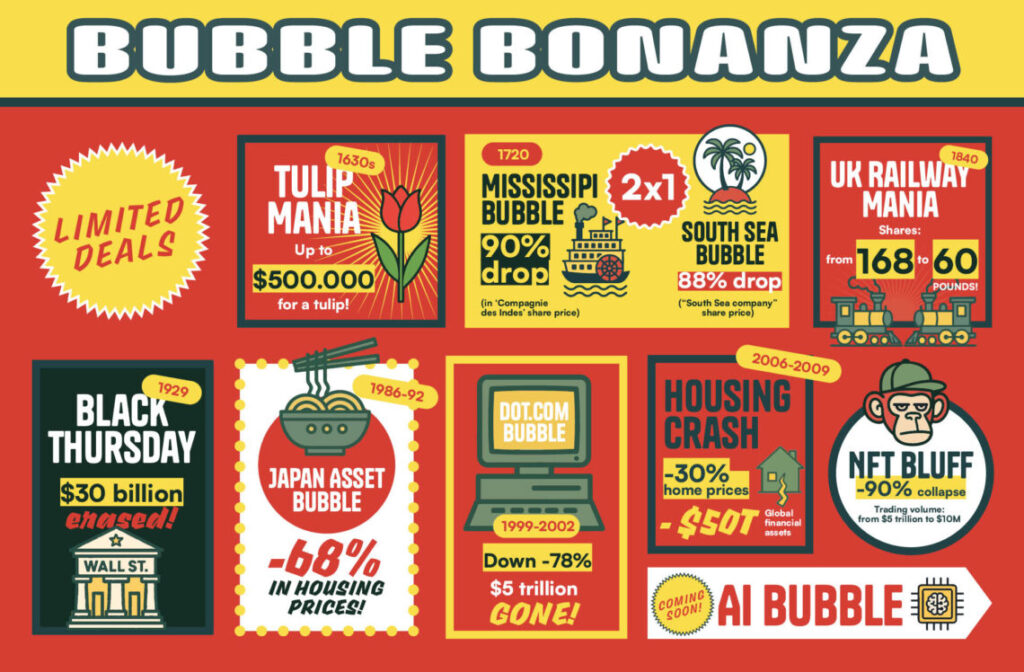
Notice a pattern? Buzzwords, grand narratives, absurd business economics, etc. Now, let’s review a couple of the largest AI rounds of the year and see if there might be some parallels.
Humane AI
The Humane AI pin was meant to be a $700 wearable AI assistant, but the hapless machine was just massacred by users: “Not even close”, “the worst product I’ve ever reviewed”, “solves nothing and makes me feel stupid”, etc. Pouring salt on the wound, the device had to recall its charge case over a fire hazard. It swallowed up over $240 million from people like Microsoft or Sam Altman, the Open AI CEO, ultimately sold to HP for half the money so they could scrap it and reuse the patents.
Rabbit R1
The $199 Rabbit R1 AI portable assistant was exposed as “just an Android app,” and also has some rather funny online reviews: “What a piece of shit”, “I bought Rabbit R1 so you don’t have to” or “Barely reviewable” are some of the first videos that you’ll see if you google it up. It sucked up about $70 million at a $175 million valuation and has fewer than 5.000 daily users.

And more
Inflection AI, an AI chatbot company aimed at “empowering people and brands with human-centered, emotionally intelligent AI” was valued at over $4billion before Microsoft paid $650 million for the assets and hired most of the staff—the chatbot itself was terminated.
And while some unicorns like Stability AI are already failing in the market (low revenues, layoffs, management clashes), most AI investments defy common sense even before the company has a chance to fail. Elon Musks’s xAI (which I can’t resist adding means ‘sheep’ in Catalan), for example, raised $6 billion at a valuation of 18 billion, with just a language model and a logo. Devin, an AI software generator, whose “announcement tweet alone garnered 30 million views”, raised 175 million dollars at a valuation of $2 billion just six months after being incorporated.
Figure AI, Databricks, Adept, CoreWeave, and even Mistral (Europe’s own AI silliness, with a valuation of almost 12 billion dollars), are other stupendous born-to-be-unicorns that are commanding billion-dollar valuations without bothering to worry about being a business.
It's the usual
Advances in Artificial Intelligence are very real and look set to profoundly transform almost every industry. The potential of AI is indisputable. But when a niche sector swallows up half of the world's venture capital at crazy valuations, with non-existent business models and dismal failures... we've seen it all before. If it looks like a bubble, smells like a bubble and bubbles like a bubble, then it is a bubble.
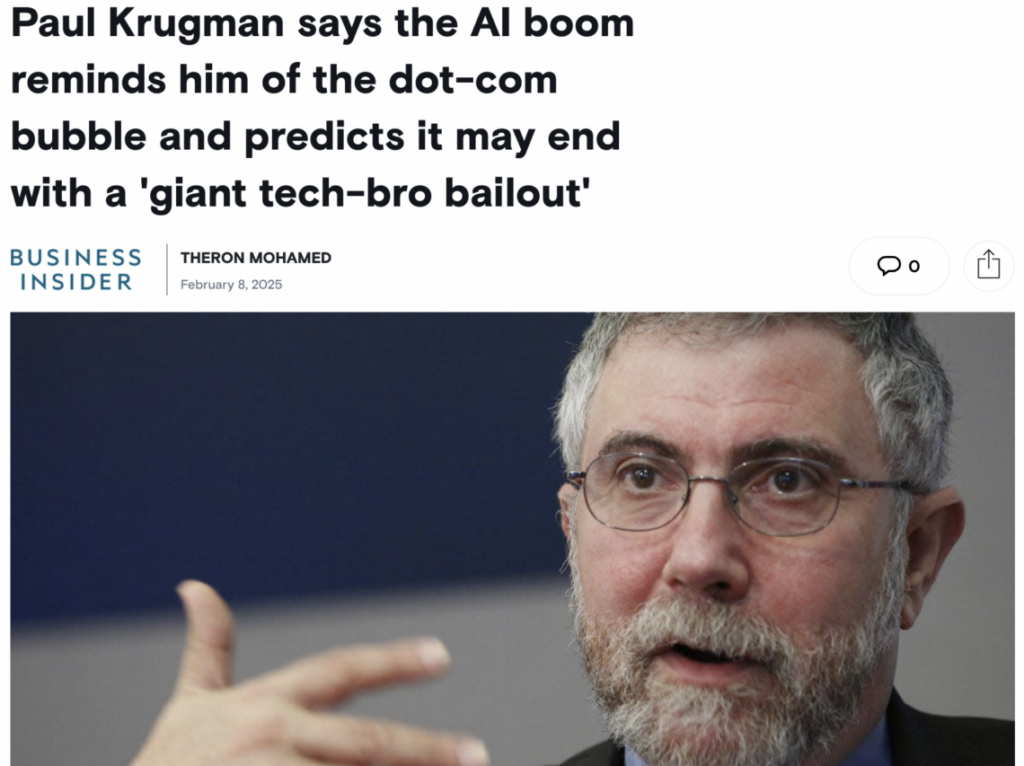
And this is not just me whining: Reuters and The Economist are already plainly saying just that, and a very smart corollary from Nobel-Prize laureate Paul Krugman adds that this bubble will not end with CEOs in jail (much like the 2008 global housing scam, actually). The Tech giants leading the AI bubble (Amazon, Apple, Microsoft, PayPal…) were once rebel hippies trying to disrupt the system, but now they are the system—one of them was even co-president of the USA, for crying out loud. So… if this ends badly for someone, we can rest assured it won’t be them.
So, if it ends badly for anyone, you can be sure it won't be for them.
But let’s go back to biotech investment. After three very bad years, investors and founders are wondering if there’s light at the end of the tunnel, and (even worse) if that light wouldn’t happen to be an oncoming train. Is the whole system just transforming forever, and were the old assets and investment paradigms flawed?
The AI bubble shows us that no, nothing has changed: "plus ça change, plus c'est la même chose". Capital is just capital, with all its gimmicks: hypes, euphoria, depression, lack of oversight, lack of foresight, dark dumbness, stereotypically macho decision-making, and the odd brilliant moment. And, logically, it will inevitably do what it always does: cycle back up.
For now, AI remains the giant magnet sucking up all the world's dollars, but that capital will flow back into biotech (or renewables, or aerospace, or any other forgotten sector) as soon as AI becomes saturated and collapses, or as soon as biotech begins to deliver its long-awaited (and hard-earned) profits. Whichever comes first.
It's recovering
Either way, biotech investments (and exits) seem to be recovering.
Big pharma has been able to scoop up some biotechs with promising early data at reasonable prices: Q1 2025 saw the highest startup acquisition volume since 2021 ($71 billion), and 2024 saw the highest number of startup acquisitions since 2020. A late-2024 survey found about two-thirds of VC fund managers expected the exit climate to improve in 2025, a big jump in optimism from the year before.
Also, remember the "patent cliff": Big Pharma still faces losses of hundreds of billions to patent exhaustion, and they sorely need to acquire new assets; biotech startups being their main source of new assets, investors and founders still have reason to be optimistic.
It's your choice
Human health is not a fad: in fact, along with climate, it is the number one challenge facing humanity, a thousand times more important and complex than any challenge AI is currently focusing on.
Overpopulation, unmet medical needs or environmental threats mean more demand for innovation in the long run, and Big Pharma’s pipeline shortages haven’t been magically solved by AI-generated videos of kittens.
So, if you’re investing now, enjoy shopping for great assets at killer prices. And if you’re not anymore, just hold on to your shares in that surviving biotech company; they’ve had a tough three years, but they never lost the opportunity to become tomorrow’s acquisition target… even if it takes 10 years instead of the 3 to 5 they promised.
And anyway, investing in good things is its own reward, isn't it?
Stimmen Sie sich auf die Zukunft der Gesundheit ein
Schließen Sie sich unseren mehr als 20.000 Abonnenten an und erfahren Sie das Neueste über Investitionen und Innovationen in der Biotechnologie.


* Was nehmen Sie an?
1 wöchentliches Mailing mit einem Artikel über überraschende wissenschaftliche Durchbrüche und einem (manchmal) witzigen Artikel über Innovation und Investitionen.
1 wöchentliche E-Mail mit aktuellen Informationen zu den Investitionen Capital Cell in neue Unternehmen im Gesundheitssektor.
Es handelt sich nicht um eines dieser "Oh nein, meine E-Mail ist im Internet"-Abonnements. Wir werden Ihre Daten niemals an Dritte verkaufen, versenden oder weitergeben. Außerdem können Sie sich jederzeit abmelden, ohne dass wir Ihnen weiterhin unverhohlen E-Mails schicken; wenn Sie uns bitten, Sie in Ruhe zu lassen, werden wir das tun.