
Ever heard of Loretta Pleasant? Probably not, and yet she might well be the first immortal human that we know of.
Loretta, who would later change her name to Henrietta Lacks , had an inauspicious start to her run as immortal superhero: raised in a (former) slave cabin in Virginia by relatives after her mother died when she was 4, she married her cousin, and she died of cancer in 1951 at the age of 31. Admittedly, not the best-dealt cards.
But Henrietta’s tumor cells were biopsied from her body (without consent) and showed a most unusual characteristic: they didn’t die after a few division cycles, as cells usually do. In fact, they haven't died to this day and, under the name ‘HeLa cells’ they have been used in thousands of key medical developments, including the polio vaccine, Cisplatin (one of the world’s most common chemotherapies), AIDS antiretrovirals, CRISPR or the COVID vaccine.
All in all, medicines developed thanks to Henrietta’s immortalized cells have saved an estimated 700 million lives.

While Henrietta’s legacy (and her cells) still lives on, and has positively changed the world, this might not be the type of immortality you have in mind – it’s safe to assume most people would aspire to more than just living forever on a Petri dish.
So, how close are we to making not just a few, but all of our cells immortal?
Immortality is already coming
In 1900, average life expectancy at birth was shockingly low – around 32 years globally, and around 45 in wealthier countries. Today, global life expectancy is about 73 years, and many nations far exceed that (Japan and Spain lead at over 84 years). We've essentially doubled life expectancy in a mere 100 years .
Clean water and sanitation alone, along with substantial changes in Health and Safety and lifestyle choices, gave us an extra 20-30 years of life. Vaccines for smallpox or polio, antibiotics (who turned fatal bacterial infections into curable inconveniences), and advances like safer childbirth, blood transfusions or insulin, added another 10-15 years to our lives.

In the 1960s, 70 was widely considered the ceiling for human life, which seems ridiculous now – we absolutely blew past that. For example, my dad just came back from touring New Zealand for a month at the age of 76, a fact that is now considered extremely normal.
Aging is a disease and can be cured.
If we transported a modern doctor to the middle ages and he were to declare that someone died of a disease called cancer, people would be dumbstruck. “Cancer? What’s that? He just died of natural death”, they would say – then burn the doctor at a stake, as was the picturesque custom back then.
Likewise, accepting that death by old age is inevitable might make us just as ignorant than Middle Age Europeans, albeit with significantly less witch burning.
Aging, like cancer, can be thought of as a disease that stems from the alteration of biological mechanisms. Thus, it has pathways that can be modified, and processes that can be stopped or reversed. In the words of Harvard geneticist David Sinclair: “I believe that aging is a disease. I believe it is treatable… and I believe we can treat it within our lifetimes.”
Let's see where we stand: a quick tour of current research in Geroscience.
“Young Blood”: Parabiosis
Common sense dictates that drinking the blood of a young maiden makes you younger—or at least it did to romantic novelists and to a bunch of weird people with freakish websites (these links may be offend delicate sensibilites, beware!). But for people whose job is to actually distinguish fantasy from reality (a.k.a. scientists), this vampiresque field of research kicked off after a 2005 study published in Nature (Conboy et al.), where two living mice were surgically joined so that they they shared a single circulatory system. When an older mouse was paired with a younger one, it showed signs of rejuvenation.
There are two main theories to explain this: old blood has “bad things” that make you age, and/or young blood has “good things” that make you rejuvenate. Bruce Willis would describe that as “no shit, Sherlock”, which kind of sums up the lack of scientific understanding of the roots of this phenomenon.
With such hazy scientific foundations, the least one would expect is for some American to launch a startup . And indeed, a company called Ambrosia started offering rejuvenating plasma transfusions to an eager public, at $8,000 a pop. Over 600 people bought it before the FDA shut the whole thing down due to its utter lack of medical basis and the extraordinary ethical and clinical risks associated.

“Zombie Cells” – Senolytics
As we age, some cells become senescent: alive but dysfunctional, secreting harmful inflammation and poisoning everything around them – a little like the current governments of a couple of global superpowers, you might say.
The percentage of senescent cells in a normal teenager is 0-1%, but it grows to about 15% in a 70-year-old man; these cells seem to be both the cause and the consequence of aging, and thus a prime target for Pharmaceutical companies. Over 20 clinical trials for senolytic drugs are underway, with early positive results in indications as varied as Alzheimer's, pulmonary fibrosis, and osteoarthritis.
“Clearing the cache” – Epigenetic Reprogramming
You probably know that almost any human cell can be "reset" into a Stem Cell, effectively reverting it to pluripotency so that it can then become any other cell – a discovery first presented to the public in 2006 by Nobel Prize winner Shinya Yamanaka.
But instead of resetting the whole cell, a few factors, such as DNA methylation or histone modification, can also be tweaked, thereby rejuvenating the cell without fully returning it to its "fetal" state . In 2021, a remarkable experiment partially restored vision in aged mice using Yamanaka factors, essentially rejuvenating the eye cells.
Backed by over $3 billion in investment, startups like Turn Bio and Altos are developing aging-reversal therapies based on factors with names as beautiful as OCT4, SOX2, KLF4, or c-MYC. It sounds like science fiction, but early evidence suggests it might be possible to rejuvenate organs or treat age-related damage by epigenetic reprogramming.
“Longevity genes” – Genome editing
It’s relatively well-known that some genes extend lifespan in animals. Forkhead Box O (FOXO) genes, linked to DNA repair and cell stress resistance, have proven capable of extending lifespan in worms or flies. It is also established that some particularly long-living humans have certain varieties of FOXO genes (notably, Japanese and Italians), so the idea arose: can we use modern CRISPR technology to edit human genomes and give everyone longevity genes?
Although widespread editing of perfectly healthy human genomes sounds like an idea straight out of a Nazi eugenics nightmare, and despite an extremely adverse regulatory environment, investment in CRISPR longevity research has increased 12-fold since 2016 .
“Rewinding the clock” – Telomerase therapy
Every time a cell divides, its telomeres—the protective caps at the end of DNA strands—get shorter, until eventually the cell can’t divide anymore. This ticking clock is one of the fundamental mechanisms of aging. In the 1980s, scientists discovered an enzyme called telomerase that can rebuild those caps and extend a cell’s life. It won the Nobel Prize in 2009, and the world went all googly-eyed with imagination: rebuild the telomeres, regain your youth.
Unfortunately, messing around with telomerase tends to cause, and very easily, big fat cancers. And while companies like BioViva or Libella are testing gene therapies to reverse aging by restoring telomeres, most of the telomerase hype is gone, along with several hundred million dollars’ worth of investment.
“Being Rich” – Digital Health and AI
In a surprising turn of events, modern technology has shown that being very rich can significantly prolong life. A plethora of wearables, AI, and biological tests (genomic, metabolic, microbiomic, etc.) can be integrated to predict and prevent health decline.
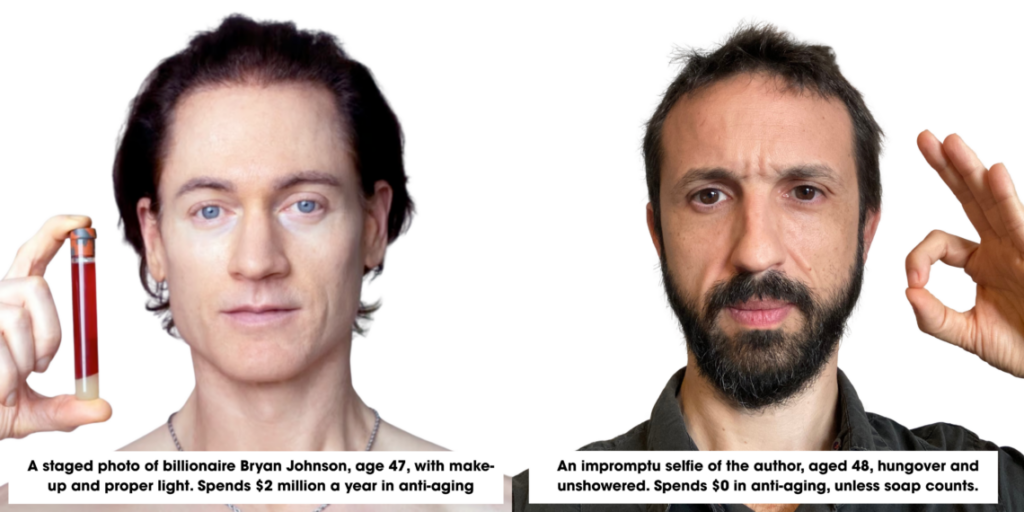
Take Bryan Johnson, a Silicon Valley entrepreneur, who reportedly spends $2 million per year on a meticulous anti-aging regimen ("Project Blueprint") which includes testing and tracking hundreds of biomarkers, as well as getting blood transfusions from his son. “For every 12 months that pass, I only age 7.6 months”, he claimed. While the results of his regime might be questionable, even laughable, and somewhat cringey, it highlights the extremes some folks are willing to go to so they can delay aging.
Adding life to years, not just years to life
The average European life expectancy is close to 78, but the healthy life years (the number of years a person is expected to live without disability or major limitations in daily functioning) is only 64, meaning we'll spend roughly 15 years of our lives in poor shape. This, of course, is an average: if you’re reading this and you’re 76 and pretty healthy, then you’re just like my father (or you’re my father: in that case, Hi dad 👋, see you tuesday).
So… living to 110 might sound great, but not if it means spending the last 30-40 years bed-ridden and yelling at the TV. That’s why the word of the day is “Healthspan”, the number of years spent actively and in good shape.
Importantly, improving healthspan seems essential to ensure our society’s sustainability. Longer healthy lives mean lower healthcare costs, more productive years, and happier adults. In 2020, Americans over 65, 17% of the population, accounted for 37% of healthcare spending . At this rate, the world's welfare states are destined to collapse.
That, plus the fact that retirement ages will be pushed back to around 70 in the next decade, plus the super-billionaires’ eagerness to be young and healthy forever, mean that medicine is significantly reorienting its priorities towards extending healthy years, not just living years. Sounds good, right?
Investing in the Fountain of Youth
The overall VC investment in longevity medicine back in 2000 was below $100 million, which is basically nothing. Twelve years later, in 2012, it was close to $200 million, which is double nothing. But twelve years later, in 2024, it flew past $9,5 billion, almost 50 times more.
In 2015, there were around 50 companies researching anti-aging tech; today, there’s well over 250—that we know of. The Senolytic drug market alone is poised to grow at a rate of 35% per year for the next decade, and the overall “longevity economy” has been estimated to grow to $600 billion by 2030.
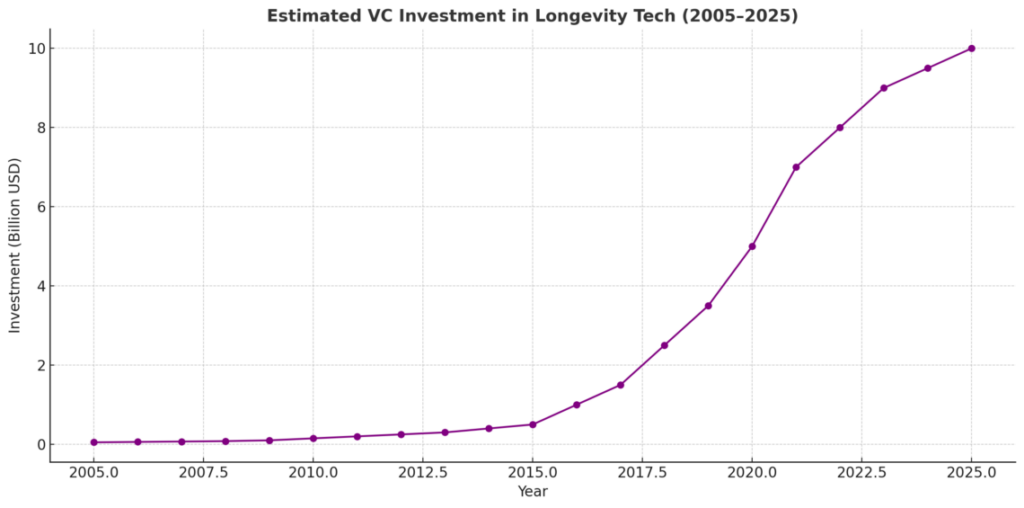
But… were people not interested in investing in youth before? Sure they were, but the reason for this late surge in investment is rather simple: the technology didn’t exist before, or—as in the case of Telomeres—was shaky at best. Senolytics or epigenetic reprogramming, on the other hand, seem capable of delivering results, much as Immunotherapy or mRNA vaccines have done in recent years.
And that is the key behind this money surge: it’s backing real science, delivering real technical solutions to problems—even if this particular problem isn’t, in fact, a real problem.
The inevitable philosophical ending
Talking about immortality requires, inevitably, a philosophical conclusion. Overdelivering, here are two:
1: People who most want immortality are scary
The people who seem more interested in eternal life seem to be billionaires, movie villains and leaders of industry – in other words, males with an abnormally high ratio of psychopaths. Pushing their agendas for a hundred years, or looking young and pretty so they can “score with chicks” at the age of 90 seem to be overly appealing for just the kind of people you probably wouldn’t want to have around for centuries – or at all, if possible
Given the choice between giving everyone a much longer life, including power-hungry megalomaniac billionaires and nuclear-powered dictators, or not giving it to anyone, what would you do?
2: We're vain enough already, thanks.
Our society is already riddled with superficiality, and the possibility of staying young and beautiful forever is unlikely to boost the pursuit of wisdom and transcendence. And while there’s nothing wrong with looking good (I’m told), one might argue that if you’ve been around for 70 years and you still define your value as a person by a full head of hair or a pair of firm breasts, you may have missed on most of life’s good things.

These considerations are, of course, just cheap philosophy; what is really real is that a healthy and active life without infirmity is extremely desirable, and that we can reasonably expect massive changes in that area in the next 20 years. If you’re in your 30’s or 40’s, it might completely transform your old age, and if you're over 70 (hello again, Dad), you may have missed this, but rejoice: your grandchildren will get to enjoy it in full.
If we don't blow up the planet first, that is.

Stimmen Sie sich auf die Zukunft der Gesundheit ein
Schließen Sie sich unseren mehr als 20.000 Abonnenten an und erfahren Sie das Neueste über Investitionen und Innovationen in der Biotechnologie.


* Was nehmen Sie an?
1 wöchentliches Mailing mit einem Artikel über überraschende wissenschaftliche Durchbrüche und einem (manchmal) witzigen Artikel über Innovation und Investitionen.
1 wöchentliche E-Mail mit aktuellen Informationen zu den Investitionen Capital Cell in neue Unternehmen im Gesundheitssektor.
Es handelt sich nicht um eines dieser "Oh nein, meine E-Mail ist im Internet"-Abonnements. Wir werden Ihre Daten niemals an Dritte verkaufen, versenden oder weitergeben. Außerdem können Sie sich jederzeit abmelden, ohne dass wir Ihnen weiterhin unverhohlen E-Mails schicken; wenn Sie uns bitten, Sie in Ruhe zu lassen, werden wir das tun.