Cancer is becoming a disease that needs continuous monitoring
Cancer cases are expected to rise from 20.6 million in 2024 to 34.4 million by 2050, a 67% increase. At the same time, cancer is increasingly becoming a chronic disease: 53.5 million people now live more than five years after diagnosis. This creates a growing need not only to detect cancer, but to monitor how it evolves and responds to treatment over time — today reliant on imaging, biopsies and complex molecular tests that are difficult to repeat frequently.
A faster, simpler way to monitor cancer from a blood sample
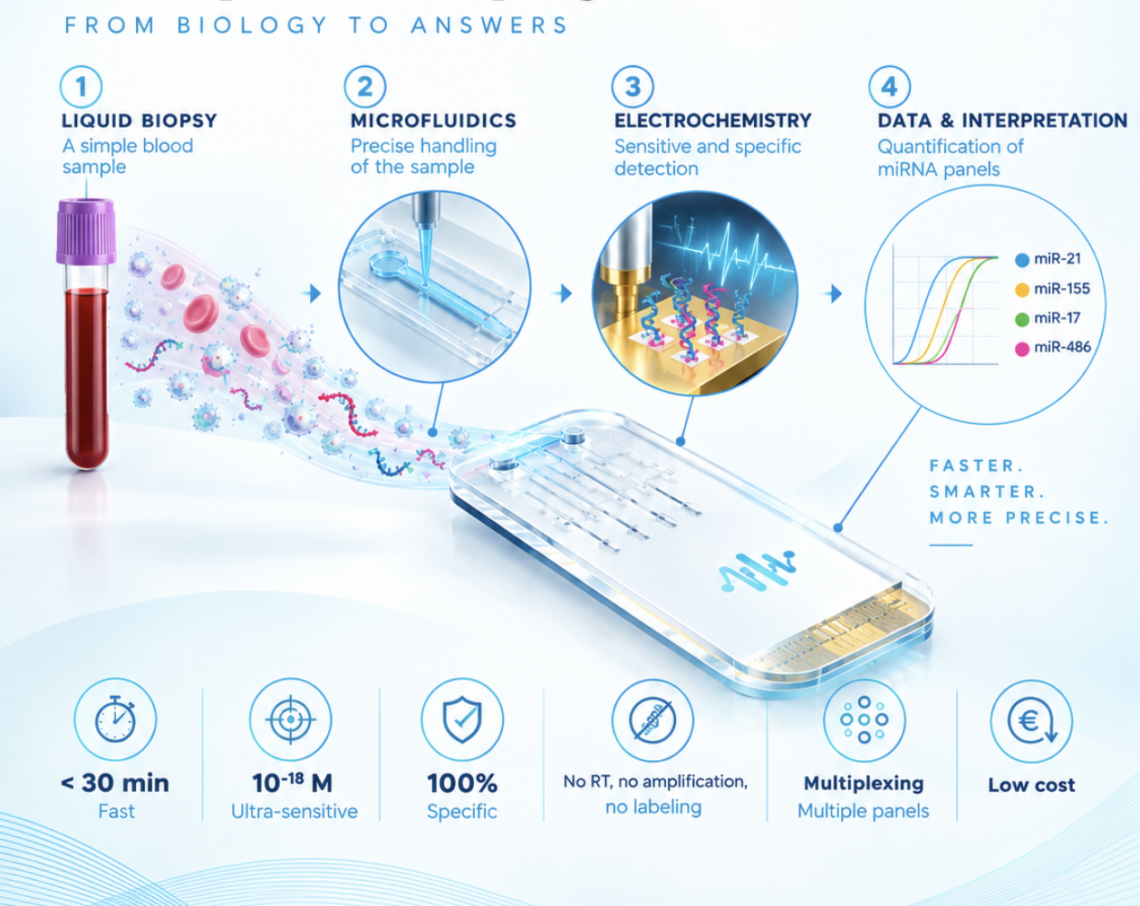
e-miRgency is developing a new generation of blood-based molecular testing designed to make cancer monitoring faster, simpler and more accessible. Its patented platform directly detects and quantifies circulating microRNAs from a blood sample, delivering results in under 30 minutes. Initially focused on colorectal, lung and breast cancer, e-miRgency aims to provide an additional molecular signal to assess treatment response and disease evolution.
MicroRNAs: a fast-growing biomarker frontier in precision oncology
MicroRNAs are small molecules naturally released by cells into the bloodstream. Their levels change with biological activity, including tumor development and response to therapy, making them promising biomarkers for precision oncology.
Despite decades of research, their routine use remains limited because conventional measurement generally requires amplification, labeling, specialized equipment and laboratory expertise. e-miRgency removes these barriers by measuring microRNAs directly, without amplification or labeling — its chip and compact reader analyze several microRNAs simultaneously, with sensitivity matching RT-PCR, the reference laboratory method.
10+ years of CNRS research, now moving toward the clinic
The technology results from more than ten years of CNRS-backed research across four laboratories and is protected by two patents under an exclusive license from CNRS Innovation. Proof-of-concept work has demonstrated direct detection across a wide concentration range, high selectivity and eight-channel multiplexing. e-miRgency has progressed to a functional laboratory prototype and is now entering industrialization and clinical validation, with a first oncology study at Institut Gustave Roussy and INSERM benchmarking the platform against RT-qPCR.
A rapidly growing market for microRNA-based oncology diagnostics
The global oncology in-vitro diagnostics market was approximately $20 billion in 2024, while the emerging microRNA-based oncology diagnostics segment is estimated at around $500 million and growing at approximately 18.2% annually.
e-miRgency sits at the intersection of two structural trends: the expansion of precision oncology and the growing need for minimally invasive, repeatable monitoring as more patients live longer with cancer.
A recurring-revenue model built around every test
e-miRgency’s business model is designed for scalable, recurring revenue: initial adoption by academic and research labs, followed by hospitals and cancer centers, biotech/pharma companies, and ultimately international diagnostics networks.
Instrument placement drives recurring sales of disposable test chips, complemented by custom microRNA panels, services, partnerships and licensing. As the installed base grows, consumables should become the core revenue stream — a platform model that can expand across indications and geographies.
Scientific expertise backed by pharmaceutical and clinical experience
The company combines scientific depth with experienced leadership. CEO and co-founder Olivier Lavergne is a pharmacist and HEC graduate with 25 years across Sanofi, Pfizer (Président Pfizer ConsumerHealth) and GSK. CTO and co-founder Jean Gamby, a CNRS Research and Department Director, invented the core technology. Clinical development is supported by experts from Gustave Roussy, INSERM and Sorbonne University.
Clinical collaborations, biotech demand and multiple validation milestones already in place
e-miRgency has already achieved a series of milestones supporting its potential:
- First clinical study underway with Institut Gustave Roussy and INSERM
- First biotech letter of intent demonstrating early industry interest
- €800,000 committed (first tranch of €500,000) by an experienced medtech/biotech Business Angel toward the €2 million financing plan
From validated prototype to first commercial launch
The timing is pivotal: e-miRgency is moving from a validated laboratory prototype toward an industrialized product, targeting first commercial Research Use Only launch by end-2027, followed by clinical IVD expansion in France and Europe.
The current financing will fund industrialization, clinical validation, regulatory preparation and initial commercial deployment.
e-miRgency is entering a value-creation phase in which more than a decade of research, protected intellectual property and leading clinical partnerships can be converted into a scalable diagnostics business.