Nearly two out of three cancers result from protein kinase dysfunction. Kairos Discovery is developing a portfolio of targeted therapies, including KDX-350 : the first highly selective oral candidate for the CK2 kinase . By exploiting a unique binding site for this protein, we have designed a molecule that surpasses existing approaches in terms of antitumor efficacy and tolerability . Protected by several patent families and supported by published preclinical data , this program has already attracted the interest of a pharmaceutical company for a potential partnership by 2027.

Completed 25 a day ago
171 investors
Investment achieved
1.004.930€
Target
850.000€
Invested
118.2%
118.2% INVESTED
This campaign was live:
From: 21 July 2026
Until: 20 September 2026
Maturity

Prototype/preclinical

Premoney valuation

3.294.118€

Estimated exit

2029-2030

Sector

Biotechnology

Equity offered

21%

Minimum investment

1.000€

Lyon flag
Equity L
Tax deduction L
close modal

Share this project on your website.

Copy and paste the following code into your content.

The content of this campaign has been generated through automatic translation.
Content automatically translated

Overview: Kairos

Valuation 3.294.118€
Estimated return x20
% Offered 21%
Estimated exit 2029-2030

An oral treatment targeting the CK2 kinase, a protein involved in the development of about ten cancers, and recognized for more than 20 years in biomedical research.

A mechanism of action validated in more than a dozen animal models, 15x more selective and 2x more effective in vivo than the first generation clinical treatment.

Kairos is targeting one of the most promising markets in oncology, accounting for more than 40% of the amounts committed in pharmaceutical oncology transactions since 2010, or nearly $100 billion in deals.

A scientific and strategic interest formalized by a pharmaceutical laboratory, with a view to a potential partnership from mid-2027.

Kairos Discovery is developing a second generation of kinase inhibitors: a reinvented approach to better fight cancers.

The advent of protein kinase inhibitors , such as Glivec® , has profoundly transformed cancer treatment, offering patients alternatives that are better tolerated than conventional chemotherapy. However, these therapies face a fundamental limitation : they only contain the disease without eradicating it , and their effectiveness diminishes over time. This is due to a mechanism of action incapable of neutralizing all the cellular signals that fuel tumor progression. A paradigm shift is therefore essential.

This is where Kairos Discovery comes in, founded in late 2022 around a program targeting the CK2 kinase , a key protein in many cancers. While giants like AstraZeneca and Bristol Myers Squibb have explored this target, their candidates have encountered the same obstacle: by attacking a site common to hundreds of other proteins, these treatments lack precision and only partially block CK2 , leaving intact the functions by which the tumor continues to thrive.

Kairos succeeded where others failed by targeting a unique, recently discovered binding site on CK2. The company is exploiting this unprecedented structural vulnerability to ensure greater antitumor efficacy , increased selectivity , and reduced toxicity . This breakthrough is no accident: it is the culmination of a decade of academic research , to which its CEO dedicated his doctoral thesis, thus positioning Kairos as a legitimate player to transform this potential into a therapeutic success .
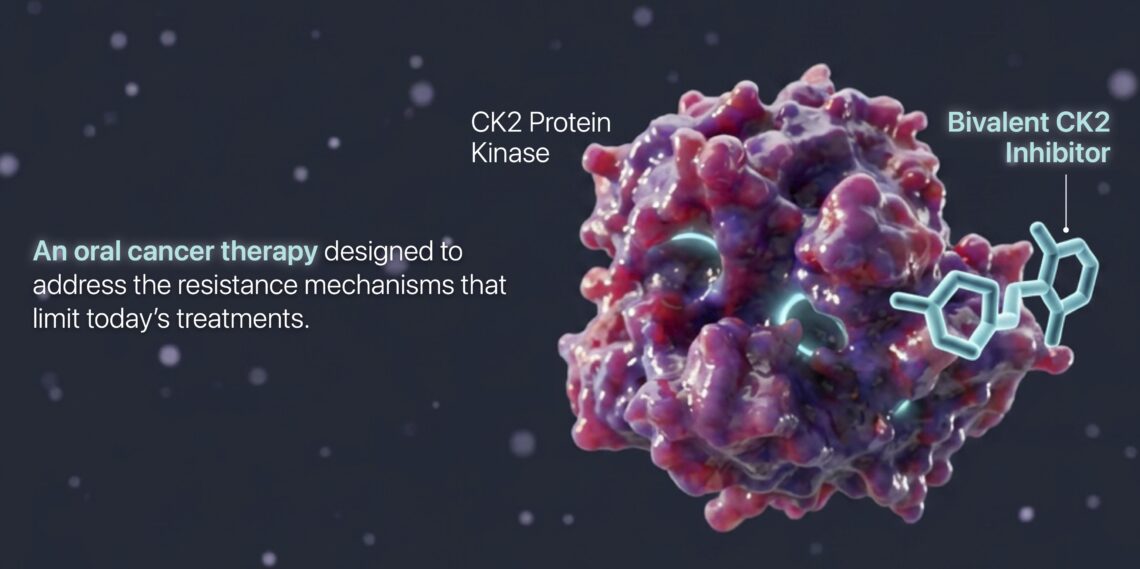
KDX-350, small molecule, strong potential

Its lead candidate, KDX-350 , a small orally bioavailable molecule, recognizes CK2 with exceptional affinity – at least 15 times greater than first-generation inhibitors – and simultaneously blocks its enzymatic activity and other functions by which it promotes tumor progression.
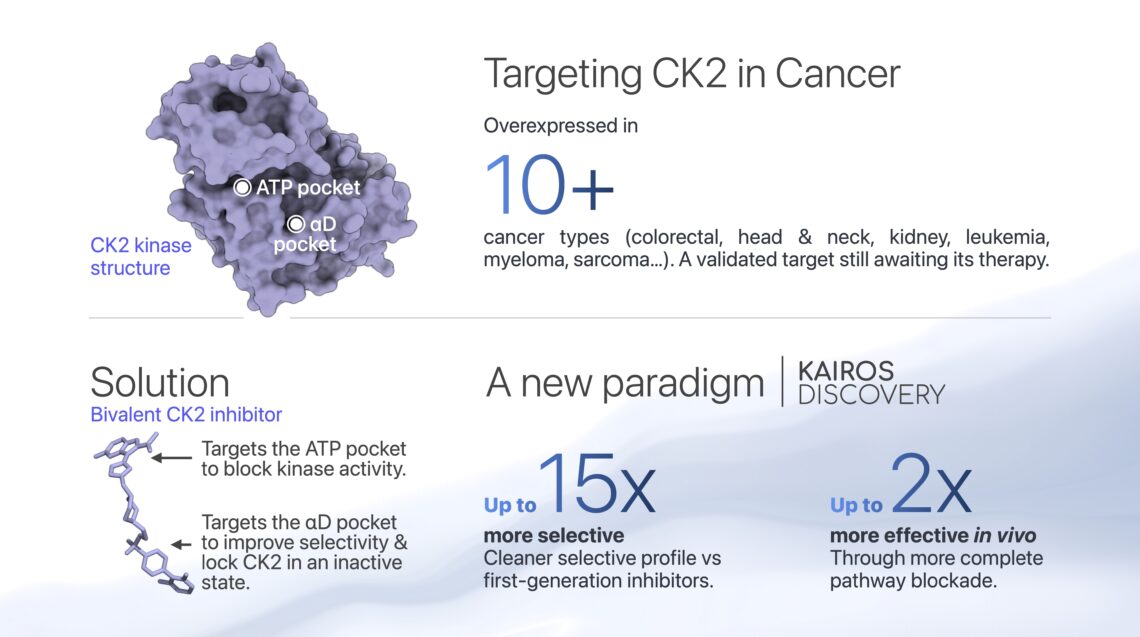
A preclinical proof of concept established in colorectal and metastatic kidney cancers, paving the way for other indications where CK2 leads tumor progression.

This approach is based on demonstrated antitumor efficacy in more than a dozen murine models , supported by pharmacokinetic and pharmacodynamic (PK/PD) data. As monotherapy, the results confirm significant inhibition of tumor growth in representative models of colon cancer (~1.9 million new cases/year) and metastatic kidney cancer (~435,000 new cases/year) , with a therapeutic benefit up to twice that of the first-generation clinical inhibitor. In combination with first-line treatments, our molecule overcomes resistance mechanisms and leads to complete tumor regression in animals, with a favorable safety profile confirmed in mice and rats.

A double winner of the i-PhD and i-Lab innovation competitions, the MATWIN Prize , and the Lyon Auvergne Rhône-Alpes Cancer Cluster Proof of Concept award , Kairos has garnered numerous accolades for the scientific advancements of this program. Several results have been published in leading international journals, including the world’s first demonstration of in vivo antitumor efficacy for a bivalent CK2 inhibitor (Link here ). The company holds exclusive rights to two patent families covering the chemical structure of KDX-350 and its analogs, protected beyond 2040 .
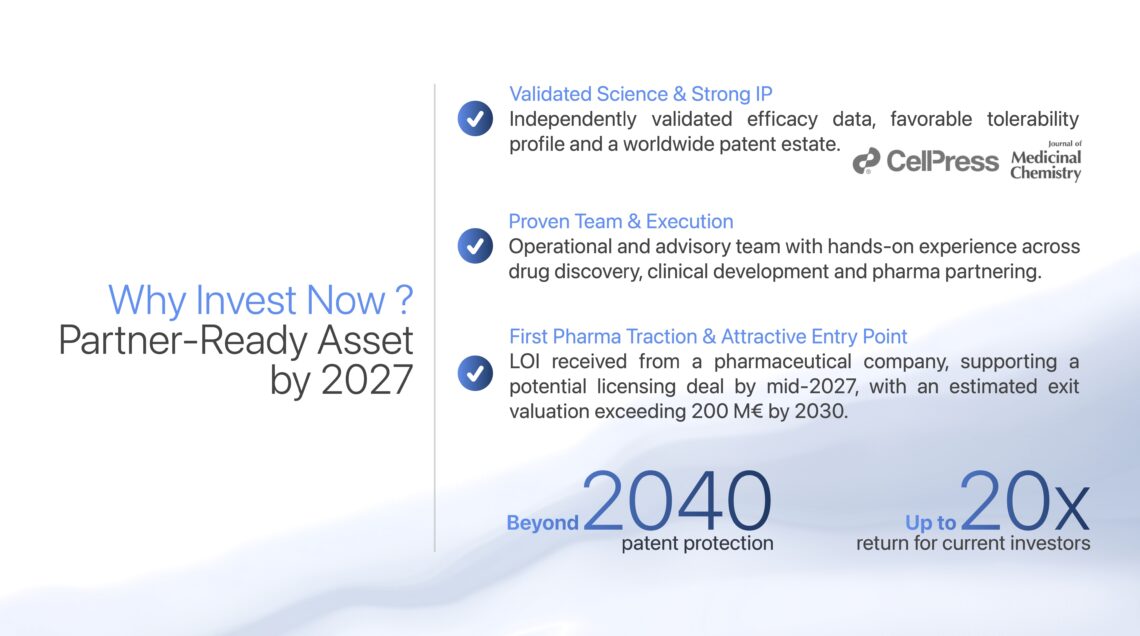
First partnership targeted for 2027

Kairos intends to build an asset portfolio around the KDX-350 . The company is currently raising over €1.5 million in funding , including €850,000 in equity, to meet the requirements of a laboratory that has formalized its interest: further pharmacological characterization, production, and regulatory preparation. A licensing agreement as early as 2027 would allow this partner to take charge of the development of the KDX-350 , while Kairos would receive exploitation rights and focus on a second program. Alternatively, a second round of funding at the end of 2027 would allow Kairos to finalize regulatory toxicology studies and begin clinical trials by 2028, marking a major turning point in valuation and the opening of new partnerships.

Science as the foundation. Patients as the horizon.

Led by Dr. Alexandre Bancet, the entrepreneur behind the project, Kairos brings together a passionate team capable of executing everything in-house, right up to the preclinical proof of concept . This team is complemented by a management committee composed of seasoned entrepreneurs with a proven track record in venture capital and company management.

Together, let’s accelerate the development of the KDX-350 at this pivotal moment for the company, as we approach our first partnership . Join us in making this innovation a reality for patients .

In Capital Cell's own words

CK2 acts as a central signaling hub that coordinates multiple survival pathways within a tumor, making it a high-level therapeutic target. However, first-generation CK2 inhibitors have historically failed due to a lack of selectivity and incomplete inhibition of the target. Kairos has addressed this issue with KDX-350. By exploiting a newly discovered structural pocket within CK2, Kairos designed a dual-action molecule that targets both the catalytic site (which promotes tumor progression) and a survival-regulating site (whose inhibition enhances the anticancer response). This simultaneous inhibition neutralizes the protein’s function far more comprehensively than first-generation drugs that targeted only a single site.

As a monotherapy, Kairos’ therapeutic approach is supported by robust in vivo data demonstrating sustained inhibition of tumor growth in renal and colorectal cancer models, offering up to twice the therapeutic benefit of first-generation clinical inhibitors. Nevertheless, its primary clinical application will likely be in combination with standard treatments; preclinical studies have already demonstrated strong synergy with chemotherapies and immune checkpoint inhibitors, particularly in settings associated with poor overall survival, including tumors resistant to conventional therapies.

Its differentiated mechanism of action and robust preclinical data have already attracted formal interest from a pharmaceutical company. In this context, Kairos is advancing KDX-350 to further reduce development risk by structuring the key pharmacological, CMC, and regulatory elements required for clinical development and licensing. This strategy is designed to enable a licensing agreement as early as 2027, which remains the primary objective of the current funding round. Given that similar early-stage oncology deals in this sector have exceeded $500 million, participating in this round at a pre-cash valuation of €2.8 million offers significant upside potential as the company achieves these critical milestones. Led by drug discovery veterans and supported by a board with a proven track record in venture capital and strategic transactions, Kairos has the oversight and expertise required to bring these assets to the clinic.

Minimum investment: 1.000€
Type of exit expected: Licensing / Acquisition (M&A)
Drag-along rights
Tag-along rights
Preferential liquidation rights
Anti-dilution rights
Tax deductions
Investing in the capital of a company, such as a JEIR (Young Entrepreneurial Research Institute), allows you to benefit from an income tax reduction equivalent to 50% of the amounts invested, under certain conditions. The investor must be an individual (private citizen or sole proprietor), domiciled in France for tax purposes, and must commit to holding the securities received in exchange for the investment (shares or partnership interests) for a minimum of five years. The amount of payments taken into account for calculating this tax reduction is limited to €50,000 for a single, widowed, or divorced person, and to €100,000 for a married couple or a couple in a civil partnership subject to the joint liability regime. For more information, visit: entreprendre.service-public.fr.
Main risks

As a preclinical biotech company, Kairos must overcome the translational risk inherent in moving KDX-350 from animal models to human clinical trials. The primary challenge is completing the studies required to submit an IND application and scaling up production capacity to confirm the drug’s safety and selectivity in patients. Furthermore, the company must progress rapidly to maintain its best-in-class competitive advantage against new entrants. Successfully achieving these clinical and regulatory milestones will be critical to justifying the next valuation increase and making the company attractive for a strategic pharmaceutical partnership or exit.