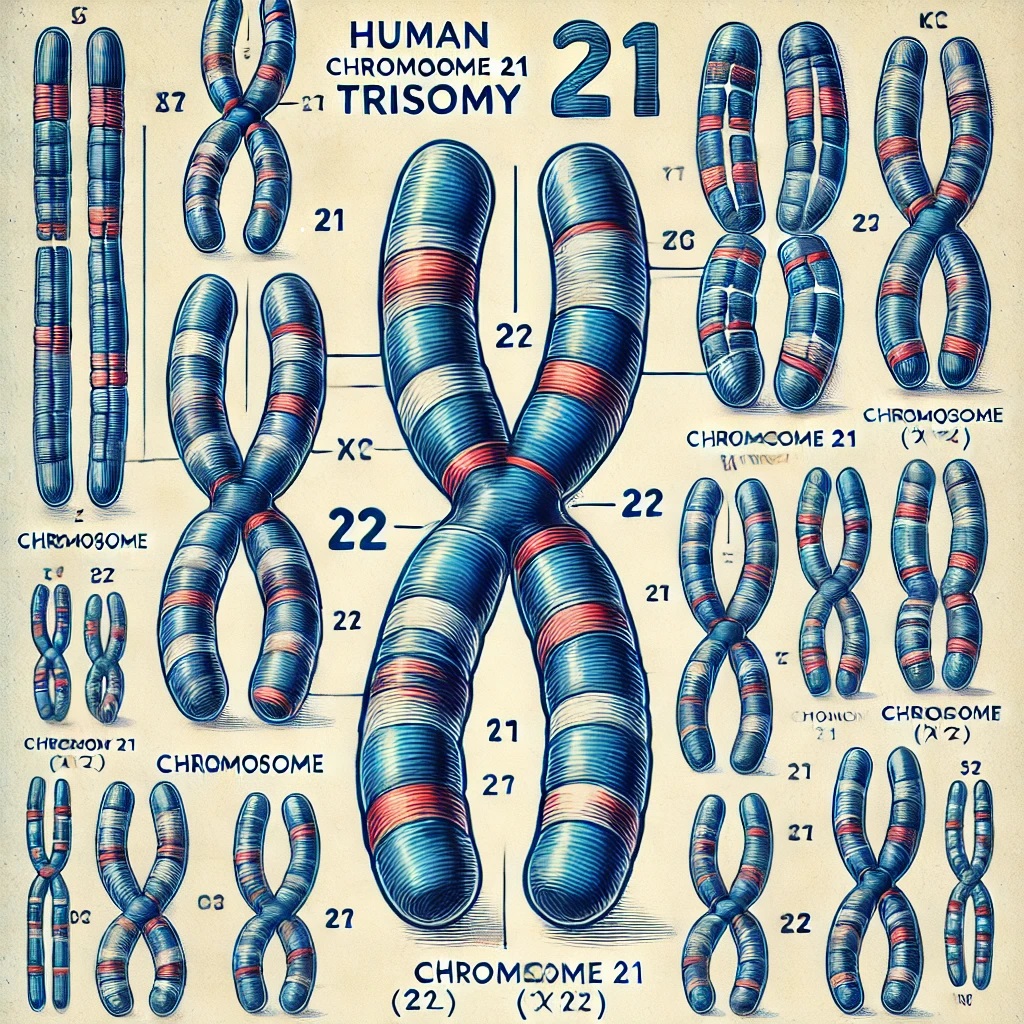

Down’s Syndrome is a common birth defect that affects around 1 in 700 births worldwide. It is caused by chromosomal abnormalities, primarily by human trisomy 21, a condition in which there are three copies of chromosome 21 in each cell of the body instead of the usual two.
Children born with Down’s syndrome have very characteristic physical traits, accompanied by intellectual challenges and increased risk of other health conditions, including heart defects and some cancers.
Cell division gone wrong
Down’s Syndrome is the most common example of a more general condition called aneuploidy, iin which an error in meiosis (the type of cell division that creates embryos) leads to an abnormal number of chromosomes (more or less that the usual 46).
As women age, the risk of an aneuploid embryo being formed increases, leading to an increased risk of giving birth to an infant with Down’s Syndrome. The risk is also higher in assisted reproductive techniques than in a natural pregnancy.
Slow progress
Despite the fact that the Down’s Syndrome was first described in medical literature in the late 1800s, and trisomy 21 identified as the most common cause more than half a century ago, few advances have been made in its treatment.
The research that has been done has mostly focused on therapies to enhance cognitive function, but as yet, none have reached the market. Actually getting rid of the extra chromosome that causes all the trouble, has so far remained out of reach of researchers.
However, a new study from Japan may be about to change that.
CRISPR/Cas9 to the rescue
The CRISPR/Cas9 gene editing tool has by now become a household name even outside the confines of the scientific community. Starting with the precise deletion, insertion or mutation of specific genes and short DNA sequences, it rapidly moved on the include larger regions of the genome and even entire chromosomes.
This can be done by cleaving the chromosome at multiple sites, the challenge being to select specific alleles (gene variants) to target, to ensure that only the desired chromosome is removed.
If this can be achieved, it opens the door to developing gene editing techniques for aneuploidy syndromes, and therapies that attack the root cause of Down syndrome.
And then there were two
The team pinpointed the subtle differences in gene expression – depending on which parent they come from – of several genes on three homologous Down’s Syndrome chromosomes.
Using this information, they were able to design the intervention to target only the duplicated chromosome, successfully returning the cell to its natural paired state, with one chromosome from each parent.
The team used pluripotent stem cells in which trisomy 21 had been induced for their experiments, and were able to demonstrate that the rescued cells exhibited normal gene expression and cellular properties. They then went on to test the same technique on skin fibroblasts, to confirm its effectiveness on differentiated, non-dividing cells.
What’s next?
The team where able to turn what used to be considered serious side effect of CRISPR/Cas9-based gene therapies –whole chromosome loss – into proof-of-concept for a novel and advantageous approach to treating Down’s syndrome and other aneuploidies.
However, a number of technological challenges remain, including a less-than-perfect elimination rate that led to mutations in the cells where the extra chromosome was not eliminated, and the limited number of cell lines and types used in the study.
Nevertheless, the study represent the first steps toward a therapy that would address the fundamental genetic causes of Down’s Syndrome. They hope to test their gene editing technique on neurons and glial cells in the future, while working on ways to improve the elimination rate.
Sintonizzatevi sul futuro della salute
Unisciti ai nostri oltre 20.000 abbonati per ricevere le ultime novità in materia di investimenti e innovazione biotecnologica.


* Cosa state accettando?
1 mailing settimanale con un articolo su sorprendenti scoperte scientifiche e un articolo (talvolta) spiritoso su innovazione e investimenti.
1 e-mail settimanale con aggiornamenti sugli investimenti Capital Cell in nuove società del settore Salute.
Non si tratta di un abbonamento del tipo "oh no, la mia e-mail è su Internet". Non venderemo, invieremo o trasferiremo mai i vostri dati a nessun altro. Inoltre, è possibile annullare l'iscrizione in qualsiasi momento senza che noi continuiamo a inviarvi palesemente e-mail; se ci chiedete di lasciarvi in pace, lo faremo.