
In 1847, there were two clinics in Vienna where you could give birth: The First Clinic, larger and run by the best doctors in the Austro-Hungarian Empire, and the Second Clinic, staffed only by midwives. But, surprisingly, Viennese mothers-to-be actually begged to be brought to the Second Clinic, sometimes even preferring to give birth in the streets instead of the dreaded First Clinic.
The reason was simple: survival, a classical human concern. The death rate for mothers in the Second Clinic was around 2%, but in the First Clinic the death rate was a staggering 15%. Yes, 1 in 6 mothers died after childbirth. In hindsight, the reason is obvious: doctors were performing surgeries, autopsies and child labor on the same day and without washing their hands – effectively, they were contaminating mothers with cadaveric bacteria, and a lot died from puerperal fever within days.
Physician Ignaz Semmelweis smelled something fishy - literally: under the (erroneous) conclusion that the corpse smell clinging to the doctor's hands might somehow be affecting mothers, he instituted handwashing with a stench-removing chlorine solution. Overnight, the postpartum mortality rate at the First Vienna Clinic dropped from 15% to 2%.
Ignaz should have been hailed as a hero of medicine, but instead... quite the opposite happened: he was attacked and ridiculed by the very doctors who were, suddenly, not unwittingly killing their patients. Offended by the notion that “a gentleman’s hands might be unclean”, the folks at the First Clinic fired Semmelweis and removed the policy, sending death rates right back to its pre-handwashing levels.

Undaunted (though understandably somewhat miffed) Semmelweis left Vienna and took a position as Head of Obstetrics at a clinic in Pest (now Budapest), where he repeated his brilliant performance: he instituted hand washing, reduced post-partum mortality to almost zero.
Despite what seems overwhelming evidence that he was onto something, his ideas were ridiculed and rejected until Semmelweis finally lost his mind and was committed to an insane asylum in 1865, where died a few days later, allegedly after a brutal beating by the guards.
For his discoveries, and for saving thousands of lives, Ignaz Semmelweis was murdered. The people who killed him (albeit indirectly) were doctors, scientists, academics, and respected members of the medical profession – exactly the kind of guys you trust with your life when you walk into a hospital.
Doctors, scientists, academics, and respected members of the medical profession, thus, can be utter fools, and their intellectual failings can mean the death of great ideas – and a great many people along with them.
So here’s a brief compendium of blindness, stupidity, rigidity and incompetence, but also of enlightenment and rebirth – there is some of that in the world too.
1. Cardiac catheters: hold my beer (1929)
Millions of people owe their lives to the invention of cardiac catheterism, the surgical technique of reaching the heart with a catheter inserted via an artery or vein, instead of by ripping open the chest. But a hundred years ago that was impossible; in fact, any type of heart surgery was impossible back then.
In 1929, a young German cardiology student called Werner Frossmann thought that it might be possible to insert a catheter in the heart to take pressure measurements or inject drugs. This was radically opposed to conventional medical thinking, which was that touching the heart in any way would kill you instantly. Undeterred by the prospect of a ridiculous death, Frossmann decided to perform the experiment on himself: he inserted a catheter through his antecubital vein, and then pushed it 60 cm until it was comfortably placed in his right atrium.
With the catheter still in place, Werner walked one floor down to the X-Ray department and took a picture of his heart, which clearly showed the catheter in the right ventricular cavity.
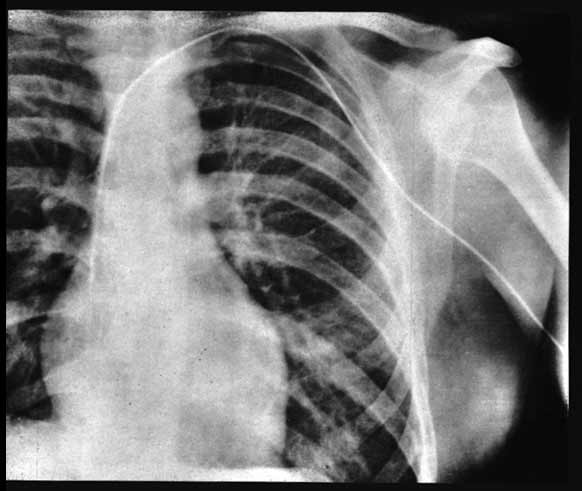
This stunning advance won him the Nobel Prize… in 1956. But in 1929, after some reluctant acceptance of the importance of his discovery, it got him fired from the hospital, and his reputation was ruined to such an extent that he had to abandon cardiology, becoming a urologist instead. Admittedly, part of that could be due to the nature of the man himself: he tied a nurse to an operating table to perform his self-catheterism, for example, and became a member of the Nazi party in 1932, way before Hitler came to power, so it’s safe to suppose that Frossmann might have been a difficult character.
Anyway, his research was rescued from oblivion by the American physicians André Cournand and Dickinson Richards (with whom he ended up sharing the Nobel Prize) in the late 1940s, becoming one of the cornerstones of modern cardiology.
And while many of the complementary technologies required to perform cardiac catheterism didn’t exist in 1929, we can make the rough estimate that, had it been massively adopted upon its discovery, 2-5 million lives could have been saved. Oh well.
2. Bacterial ulcers: The Impossible Bug (1982)
In the early 1980s, ulcers were considered to be the result of excess stomach acid due to diet and stress. “Type A” personalities were considered prone to ulcers, and thus standard gastritis treatments included Valium or psychotherapy.
The idea that ulcers could be a disease caused by bacteria living in stomach acid was considered crazy. Of course, by then it was already known that bacteria could live in geysers, salt lakes, volcanoes, radioactive waste, tar pits, Arctic permafrost, the stratosphere and possibly the moon. But... the human stomach? No way!
By 1982, Australian physicians Barry Marshall and Robin Warren had identified Helicobacter pylori in patients with gastritis and peptic ulcers, but had a hard time convincing the medical community that this bacterium lived in the stomach and was, in fact, the culprit. So, to prove the bacterium’s causality, Marshall famously drank a beakerful of H. pylori, developing a gastritis and then cured himself with antibiotics.
Despite Marshall's spectacular "performance," the scientific community remained skeptical until new studies in the 1990s confirmed the bacteria-ulcer connection, and Marshall and Warren were duly awarded the Nobel Prize in 2005.
Ulcers, once a chronic disease that often evolved into stomach perforations or cancer, thus became an easily curable disease. This has saved the world a great deal of pain, and some $150 billion in healthcare costs, enough money to pay for half of what it would cost to send Elon Musk to Mars - something that should be one of humanity's top priorities.
3. mRNA drugs: a fragile idea (1990-2020)
Messenger RNA (mRNA) seems like a natural platform to build medicaments. That tiny molecule can, simply put, tell your cells what to build - from growth factors to repairing enzymes. But for decades messenger RNA was considered useless: it was extremely unstable (it degrades like a snowflake in an airfryer the second it enters the body), and it generated strong, nearly lethal, immune and inflammatory responses. Because of that, efforts to develop mRNA-based treatments in the 1990s and 2000s were largely relegated to academic curiosities.
The pioneering work of Hungarian scientist Katalin Karikó with mRNA in the University of Pennsylvania, thus, was contrary to scientific dogma and to Big Pharma interests - and had already won her a demotion and a few years without funding by the early 2000s.
By sheer stubbornness and willpower, Karikó managed to convince Professor Drew Weissman of the validity of her work, and together they made two key breakthroughs: (1) replacing uridine with pseudouridine in synthetic mRNA, and (2) encapsulating the mRNA in a lipoparticle (a drop of fat, essentially), made mRNA safe and stable, and its huge potential in medicine could be unlocked.
That key discovery was sent to the two top scientific magazines in the world, Nature and Science… and rejected. Nature considered it "not novel" ” and “not of interest to the broad readership”, and Science also rejected on the same grounds – not innovative enough, too niche. The article was finally accepted by “Immunity” and became the seed, among other things, of the Moderna COVID vaccine (which, contrary to some, er, interesting theories , isn’t made from the Anti-Christ’s DNA but from modified mRNA).
Karikó and Weissman eventually received the 2023 Nobel Prize in Physiology or Medicine, and the global mRNA therapeutics market is projected to exceed $100 billion by 2030.

4 - Prions: molecular zombies (1982 - 1997)
In 1982, neurologist Stanley Prusiner suggested that certain mysterious and fatal neurodegenerative diseases (like Creutzfeldt–Jakob disease, scrapie in sheep, and later mad cow disease) were caused not by bacteria, viruses, or fungi, but bya self-replicating protein, something completely unheard of. He called it a prion (from proteinaceous infectious particle).
The reception from the biomedical establishment was instant and scathing. “It was truly heretical”, Prusiner wrote later. After all, how could something without DNA or RNA replicate? Prusiner’s proposals were dismissed as pseudoscience, and his work was derided as speculative and unprovable.
And yet prions are very real, as the huge piles of burning cow carcasses showed during the 1990’s Mad Cow crisis. A prion is a misfolded protein, which incapable of fulfilling its function, just lumps up and causes havoc. And it does replicate: when a misfolded prion touches a “healthy” version of the same protein, it misfolds it, effectively turning it into a new prion – yes, exactly like in the zombie movies.

Gradually, Prusiner (and others) proved that prions could transmit diseases between animals and, later, between humans, even in the total absence of DNA.
In 1997, Prusiner received the Nobel Prize in Medicine, vindicating a theory once considered absurd; if adopted earlier, it could have prevented the deaths of some 200 people and more than 4 million British cows, approximately 40% of the total UK cattle population.
5- Immunotherapy: the long rejection (1950-1990)
The immune system is designed to attack external things, but, more importantly, not to attack the body itself. When it does, what you get is autoimmune disease: multiple sclerosis, diabetes or arthritis, for example.
And cancer cells, unlike viruses or bacteria, arise from the body's own cells, and share almost all of their proteins. "Tumors are 'self,' only distorted," as a researcher put it in the New England Journal of Medicine (1976). Thus, medicine thought it was impossible for the immune system to attack tumors.
But in the 1950s and 60s, researchers like Lewis Thomas and Sir Frank Macfarlane Burnet proposed a bold idea: perhaps the immune also patrols the body for cancer. They called it tumor immunosurveillance. The idea was that immune cells, particularly T lymphocytes, might recognize and eliminate emerging tumors before they could grow into malignancies.
Immunologists largely ignored the idea, and oncologists focused on chemotherapy, surgery, and later radiation. When early versions of cancer vaccines and immune boosters failed in the 1970s and 80s, the theory of immune-mediated tumor rejection was further sidelined. By 1980, the American Cancer Society's official guideline described immunotherapy as "promising in theory, but not clinically justified."
Immunologist Lloyd Old, a staunch proponent of this theory, wrote: "The word 'immunotherapy' became almost radioactive. It was hard to get grants, harder still to publish papers and hardest of all to be taken seriously."
But in the 1990s and early 2000s, several studies proved that T cells did, in fact, attack cancer, and that tumors evolve specific mechanisms to evade detection, in an endless cycle of hunt and stealth. The next big discovery was checkpoint inhibitors: antibodies designed to “reveal” tumors and trigger the immune response (notably PD-1 and CTLA-4).
In 2011, ipilimumab, an anti-CTLA-4 antibody, was approved for melanoma, and the field of cancer immunotherapy, once considered almost pseudoscientific, exploded: over 20 new treatments, a projected market of over $1 trillion dollars, millions of patients treated and tens of thousands of patients cured.
In 2018, James P. Allison and Tasuku Honjo were awarded the Nobel Prize for their discovery of immune checkpoint regulation, vindicating the theory of immunity against cancer after 60 years of rejection.
The yin and yang of progress
All of these cases (and many more!) highlight a central paradox in the progress of medicine: transformative ideas often emerge from rejection. Resistance is not only inevitable, but can be a sign that a discovery is fundamentally disruptive.
For investors, scientists, and policymakers alike, these histories also offer a not-too-amusing lesson: skepticism is healthy, but stupidity and intellectual paralysis aren’t. And yet they’ve always been there, lurking in the shadows, the board meetings and the institutional sub-committees. And there they will stay forever, particularly if good people do nothing to stop self-serving, short-sighted fools.
And, unfortunately, there seem to be a lot of those in the circles of power - especially lately. Have you noticed?

Sintonizzatevi sul futuro della salute
Unisciti ai nostri oltre 20.000 abbonati per ricevere le ultime novità in materia di investimenti e innovazione biotecnologica.


* Cosa state accettando?
1 mailing settimanale con un articolo su sorprendenti scoperte scientifiche e un articolo (talvolta) spiritoso su innovazione e investimenti.
1 e-mail settimanale con aggiornamenti sugli investimenti Capital Cell in nuove società del settore Salute.
Non si tratta di un abbonamento del tipo "oh no, la mia e-mail è su Internet". Non venderemo, invieremo o trasferiremo mai i vostri dati a nessun altro. Inoltre, è possibile annullare l'iscrizione in qualsiasi momento senza che noi continuiamo a inviarvi palesemente e-mail; se ci chiedete di lasciarvi in pace, lo faremo.